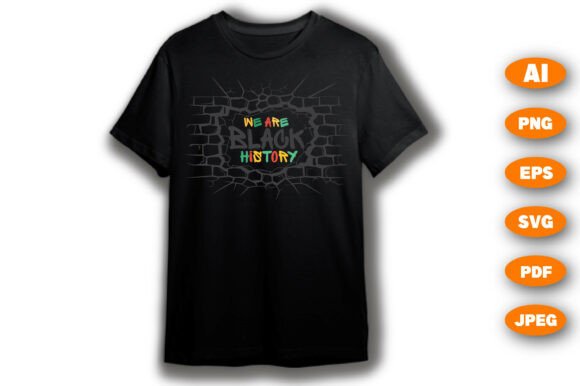
We Are Black History T Shirt Design, SVG
As a designer who’s stitched hundreds of custom pieces—from boutique aprons to nursery pillows—I opened We Are Black History T Shirt Design, SVG expecting boldness, clarity, and quiet strength. What I found was exactly that: a clean, centered phrase with intentional spacing, strong vertical rhythm, and a typographic presence that feels both celebratory and grounded. It doesn’t shout—it affirms. That matters deeply when you’re translating words into thread.
First Impressions: Simplicity That Carries Weight
This isn’t ornate script or layered graphics. It’s a confident, all-caps statement rendered in a sturdy, slightly rounded sans-serif—friendly without sacrificing dignity. The letterforms have generous counters and consistent stroke weight, which translates well to satin stitch or dense fill stitch. No delicate serifs, no overlapping letters, no micro-details that vanish under 12 stitches per cm. That’s not a limitation—it’s thoughtful design discipline.
I immediately pictured it on a heavyweight organic cotton tote for a local heritage fair: embroidered just below the shoulder seam, large enough to read at arm’s length but not so big it overwhelms the bag’s structure. The design’s balance—neither cramped nor sprawling—means it scales gracefully across fabric types and garment shapes.
Where It Shines in Real Embroidery Projects
We Are Black History T Shirt Design, SVG works especially well for projects where message and material harmony matter. Think sweatshirt embroidery on loop-wheel fleece: the clean lines hold up against texture, and the moderate width avoids puckering on thicker weaves. On baby onesies? Yes—but only if digitized with lighter stitch density and minimal underlay. The phrase itself is short enough to avoid long hooping sessions, yet meaningful enough to anchor a personalized gift.
It’s also a smart choice for embroidered patches: the even letter height and open spacing prevent thread bridging between characters. When heat-applied to denim jackets or canvas aprons, it reads clearly without requiring metallic or high-contrast thread—though switching to deep indigo or charcoal thread on oatmeal linen adds subtle sophistication.
For Etsy sellers and small shop owners, this design fits seamlessly into curated collections: holiday embroidery kits (think “Kwanzaa Gift Set” with matching tea towels), boutique branding for community-centered shops, or handmade product lines focused on intentionality over trend-chasing. As a digital embroidery file, it pairs naturally with printable mockups—especially those showing relaxed-fit tees and unstructured totes—because its visual weight holds up in lifestyle photography.
Where to Proceed Thoughtfully
That same clarity becomes a consideration on challenging substrates. On stretchy performance knits or thin rayon blends, stabilizer choice is non-negotiable—lightweight cutaway or tear-away with light spray adhesive keeps letter edges crisp. Avoid using it on highly textured fabrics like bouclé or heavy terry cloth unless you’re willing to adjust density and test extensively; dense fill areas can flatten or distort on uneven surfaces.
Curved surfaces—like caps or curved pillow covers—require careful placement. The straight-line layout means centering matters more than usual. A slight arc adjustment in your embroidery software helps, but don’t force it onto a tight crown curve unless you’ve tested the distortion first. Also, while the design avoids tiny lettering, very small hoop sizes (4") may compress spacing unintentionally—always check your digitized version’s actual dimensions before stitching.
Dark fabric backgrounds demand attention to thread contrast. This isn’t a design that relies on shadow or gradient—it thrives on legibility. Test your chosen thread colors on scrap fabric in natural light *and* under indoor lighting. A warm black thread on navy twill reads differently than the same thread on charcoal heather.
Practical Notes Every Embroidery Designer Should Keep Handy
- Always stitch a test run on scrap fabric matching your final substrate—especially for commercial embroidery or client work.
- Review stitch density: too dense on lightweight cotton = stiffness and cracking; too light on fleece = muddiness.
- Confirm hoop size compatibility—if you’re working with smaller machines, verify the design fits comfortably within your standard hoop without scaling down.
- Inspect small details: though minimal, the inner curves of “A” and “R” should remain smooth after stitching—not jagged or broken.
- Test black-and-white mockups: does the phrase retain impact without color? With We Are Black History T Shirt Design, SVG, it does—and that’s a sign of strong graphic fundamentals.
- Use proper stabilizer: medium-weight cutaway for knits, tear-away for stable wovens, and fusible + tear-away combo for lightweight linens.
- Verify licensing: since this falls under Print Templates and Graphics, confirm whether commercial use—including finished embroidered products sold online or at craft fairs—is explicitly permitted.
Why It Builds Trust—Not Just Thread Count
Customers notice authenticity faster than they notice stitch count. When someone sees We Are Black History T Shirt Design, SVG on a hand-stitched kitchen towel or a locally made sweatshirt, they sense care—not just execution. There’s no visual clutter competing with the message. That clarity builds trust in your craft business, whether you’re an Etsy seller building a loyal following or a church group making commemorative gifts.
It also supports brand consistency. If your shop focuses on mindful, culturally rooted handmade products, this design reinforces that voice without needing explanation. And because it avoids cliché visuals—no silhouettes, no abstract motifs, no decorative flourishes—it stays relevant beyond seasonal trends. That longevity increases your return on design assets.
Most importantly, it honors its subject with restraint. In embroidery, where every stitch carries intention, simplicity becomes reverence. You’re not just stitching letters—you’re anchoring identity, memory, and pride into fabric that will be worn, washed, gifted, and kept.
If you’re evaluating We Are Black History T Shirt Design, SVG for your next embroidery project, ask yourself: Does it serve the garment? Does it serve the wearer? Does it serve the story? In my experience—with totes, tees, baby blankets, and boutique merchandise alike—the answer has consistently been yes.